Export Controls: B300 GPUs Detected in China Telecom Infrastructure
Israeli security firm identifies 32 banned Nvidia chips in a state-owned network, prompting the chipmaker to downplay the impact as a minor anomaly.
By Lucia Herrera ·
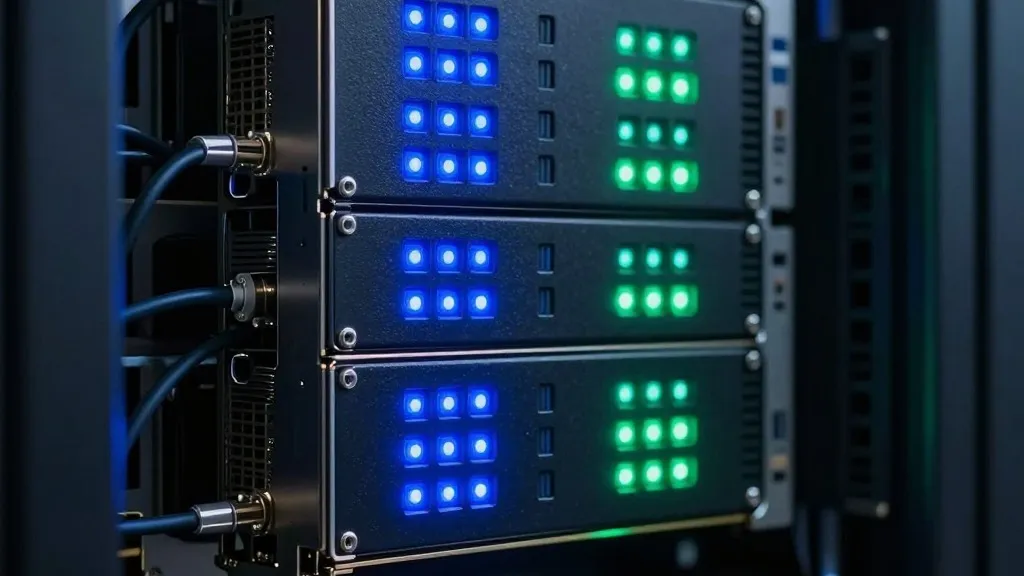
Ordinary consumers and AI developers may see little immediate change, but the discovery of 32 Nvidia Blackwell Ultra B300 graphics processing units within China Telecom’s network underscores the persistent challenge of enforcing U.S. export controls on advanced hardware. The state-owned telecommunications provider is not on the whitelist for purchasing these specific chips, which are barred from export to sanctioned parties, raising questions about how the hardware entered the data center infrastructure despite regulatory hurdles.
The findings were uncovered by Lava, an Israeli security firm, which utilized Nvidia’s own DCGM Exporter tool to identify the chips. This software, designed for data center operators to monitor server health and performance, can sometimes be accessed from outside the local network without requiring password authentication. While Lava confirmed the presence of the B300s, the exact location within China Telecom’s vast network and the specific method of entry remain unknown, leaving the mechanics of the diversion to speculation.
Nvidia has responded by minimizing the significance of the discovery, asserting that such instances of diversion are negligible compared to the volume of legitimate sales. A company spokesperson stated that recent court cases have shown controlled products being diverted at rates of less than half of one percent, describing the loss as a drop in the bucket relative to the massive amount of domestic compute capacity China already possesses. The firm maintains that with tens of millions of its GPUs in service in approved countries, smuggling remains a non-factor, especially with governments on both sides actively working to block unauthorized transfers.
The B300 chip, announced in March 2025, is a high-performance data center GPU that offers significant upgrades over its predecessor, the B200, including 50% more memory and FP4 compute capability. Positioned as hardware for the age of reasoning, the chip has become a highly sought-after asset in the AI sector. Its scarcity and power have driven up demand and prices, with even older A100 servers seeing their value triple to as high as $82,000, leading some operators to retool gaming GPUs for AI workloads where possible.
This latest detection follows a series of enforcement actions aimed at curbing the flow of Nvidia silicon into China. In August 2026, nine individuals were indicted in Taiwan for the illegal export of B300 GPUs, a case that involved a whitelisted trading firm and led Supermicro to fire several employees after an internal investigation. These events highlight the complex logistics of the smuggling trade, which often exploits loopholes in the approval process for whitelisted buyers who agree not to resell to sanctioned entities.
The broader context suggests that while export controls have slowed the flow of the most advanced chips, they have not stopped it entirely. Prior reports indicated that Chinese companies smuggled $1 billion worth of Nvidia AI chips in just three months during 2025, with distributors preparing for the B300 series even before its official release. As Nvidia continues to work on new tools to locate its chips in the field, the ongoing tension between regulatory intent and market demand remains a key factor in the global AI hardware landscape.
Source: Tom's Hardware